

Best Ceramic Mugs for Coffee: A 2026 Guide
Table of Contents
- What Makes the Best Ceramic Mugs for Coffee
- Quick Comparison: Handmade Ceramic Coffee Mugs to Consider
- Stoneware Coffee Mugs: Weight, Warmth, and Daily Durability
- Porcelain Coffee Mugs: Thinner Walls and a Cleaner Cup
- Microwave-Safe Ceramic Mugs and Glaze Safety
- Capacity, Handle Comfort, and Heat Retention in Practice
- Care, Chip Resistance, and Long-Term Durability
- Conclusion
- Frequently Asked Questions
Last Updated: October 21, 2026
What Makes the Best Ceramic Mugs for Coffee
A ceramic mug earns its place through four things: a clay body that holds heat, a glaze that survives daily washing, a handle that fits your grip, and a rim thin enough to drink from comfortably. Everything else is decoration.
The best ceramic mugs for coffee balance heat retention against weight and a comfortable rim against durability. A mug that keeps coffee hot but chips on the second wash is a bad mug; one with a handle that pinches your knuckles is worse.
Quick Comparison: Handmade Ceramic Coffee Mugs to Consider
Here is how our current mugs stack up on the factors that matter most for daily coffee drinking.
Mug |
Price |
Clay & Glaze |
Best For |
|---|---|---|---|
$45.00 |
Cinnamon stoneware, blue-to-white gradient |
Bellied shape for cappuccino |
|
Soft Beachy-Fantasy Glaze Mugs |
$45.00 |
Drippy seafoam, bronze, soft purple glazes |
A morning pick-me-up |
Sunspot Mugs |
$45.00 |
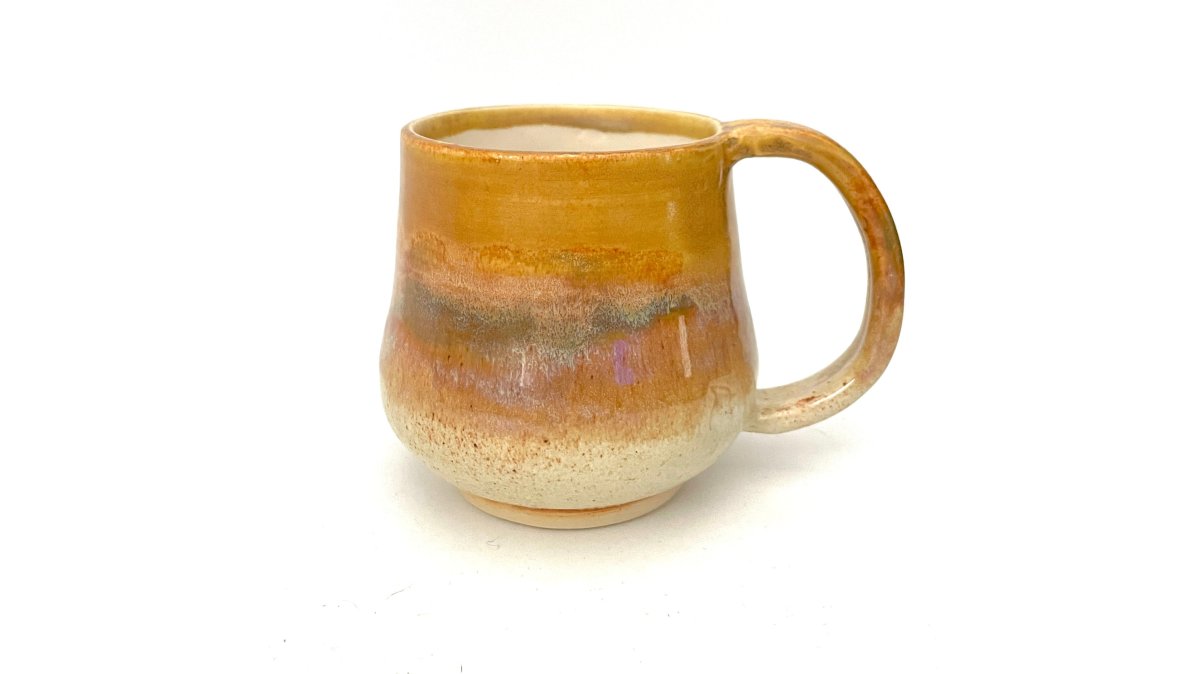
Golden and cream tones, ridged handle |
Grip comfort |
Green with Turquoise Interior Mug |
$45.00 |
Dark clay, muted green into cream, turquoise inside |
Texture lovers |
Deep Blue and White Speckled Mug |
$35.00 |
Speckled glaze |
Everyday value |
Deep Blue and White Espresso Cup |
$25.00 |
Speckled glaze, small format |
Espresso and tea |
Foggy Curved Ceramic Mug |
$25.00 |
Curved body |
Budget entry point |
Pugs Mugs |
$65.00 |
Hand-painted pug emblems |
Gifting |
Misty Mugs |
$45.00 |
Mid-range clay, reactive white glaze |
One-of-a-kind finish |
Pink and Orange Mug |
$25.00 |
Straight-sided, bright glaze |
Color lovers |
The range runs from $25 to $65, and the price difference tracks hand-painting time and clay body, not size alone.

Stoneware Coffee Mugs: Weight, Warmth, and Daily Durability
Stoneware coffee mugs are fired at higher temperatures than earthenware, making the clay denser and less porous. That density is why a stoneware mug feels heavier and holds heat longer than a thin porcelain cup.
Weight is the trade-off. A dense stoneware mug full of coffee is a two-handed drink for some people. If you have grip or wrist issues, look for a smaller body or a wider handle opening rather than a lighter clay.
Porcelain Coffee Mugs: Thinner Walls and a Cleaner Cup
Porcelain coffee mugs use a finer clay that fires to a translucent white. The walls can be thrown thinner than stoneware while staying strong: a thin rim delivers liquid with less interference, and porcelain's low porosity means it does not hold onto yesterday's flavors.
That low porosity is why porcelain suits black coffee and delicate teas, while stoneware's slightly more open body can absorb trace oils over years if the glaze is compromised.
The Three Ceramic Types, Side by Side
Most mug listings say "ceramic" and stop there. That word covers three clay bodies with different firing temperatures, porosity, weight, and failure modes.
Type |
Firing range |
Porosity |
Weight |
Heat behavior |
Typical failure |
|---|---|---|---|---|---|
Earthenware |
Lowest of the three |
Porous unless fully glazed |
Light |
Warms fast, cools fast |
Chips at the rim; glaze can craze |
Stoneware |
Mid-to-high |
Low |
Heavy |
Slow to warm, slow to cool |
Chips if dropped; dense and durable |
Porcelain |
Highest |
Very low |
Light for its strength |
Warms fast, holds moderately |
Can shatter rather than chip |
Earthenware is the lightest and least expensive of the three.
Stoneware is denser and heavier because it is fired hotter. That density is why a stoneware mug holds heat longer and why it feels substantial in the hand.
Porcelain is fired hottest and refined to remove most impurities.
note: you will not find earthenware in my lines. I use stoneware or stoneware/porcelain mixes only. All of my clays are fully useable at the midfire range I fire to, which is exactly why I chose them! I prefer clay bodies that result in beautifully usable vessels!
Porosity, Crazing, and Why They Matter for Flavor
Porosity ties all three types together. As long as the glaze is intact, the body underneath barely matters for flavor. Once the glaze crazes or chips, a porous body will take up coffee oils, stain, and eventually hold odors.
Crazing is not always a defect, some glazes are formulated to craze for decorative effect, but a crazed glaze on a food-contact surface warrants caution for daily coffee use.
How to Tell Which Type You Are Holding
- Look at the foot. A chalky, light unglazed foot ring usually signals earthenware; a dense, hard foot is more likely stoneware or porcelain.
- Check the weight-to-size ratio. Surprisingly light for its size means earthenware or thin porcelain; heavy for its size usually means stoneware.
- Hold it to a light. Thin porcelain may show faint translucency at the rim; stoneware and earthenware will not.
- Tap the rim. A clear ring suggests a dense, well-fired body; a dull thud can indicate under-firing or a hairline crack.
None of this makes one type the "best" ceramic for coffee. It makes the choice legible: earthenware for light, colorful pieces; stoneware for warmth and durability; porcelain for a clean, thin-rimmed cup.
Microwave-Safe Ceramic Mugs and Glaze Safety
Microwave-safe ceramic mugs need two things: a clay body with no trapped moisture and a glaze fired to full maturity. The FDA guidance on ceramicware and lead glazes is worth reading before you buy any unmarked mug.
For handmade pieces, ask the maker directly, a potter who fires to maturity will name the clay, glaze, and firing temperature without hesitation.
Capacity, Handle Comfort, and Heat Retention in Practice
Capacity, handle comfort, and heat retention decide whether a mug becomes your daily driver.
Handle comfort comes down to two measurements: the opening between handle and body, and the handle's thickness. The ridged handles on the Sunspot Mugs exist for exactly this reason: grip when the mug is full and heavy.

A Repeatable Heat-Retention Test You Can Run at Home
Most heat-retention claims are marketing. You can replace them with a number in about twenty minutes using a kitchen thermometer. The protocol below is the one we use on our own pieces, deliberately boring so results are comparable across mugs.
- Standardize the room. Same room, same time of day, no forced-air vent on the mugs. Note the room temperature, most kitchens sit between 68°F and 72°F, and a 5°F swing moves your readings.
- Preheat identically. Fill each mug with hot tap water for 30 seconds, then empty it. Skipping this is the biggest source of bad comparisons, because a cold thick-walled mug steals heat from the first pour.
- Pour the same volume at the same temperature. Use 8 ounces of water or brewed coffee at 195°F to 205°F, and record the actual starting temperature with an instant-read thermometer.
- Take timed readings. Measure at 0, 15, 30, and 60 minutes without stirring, in the same spot, uncovered unless you are testing a lid.
- Record the delta, not the absolute. The useful number is how many degrees the liquid dropped over 60 minutes.
A common pattern across ceramic mugs: a thick-walled stoneware mug of 10 to 12 ounces typically loses heat more slowly than a thin porcelain cup of the same volume, because the heavier wall carries more thermal mass.
What Actually Moves the Number
- Wall thickness and clay density. More mass means slower cooling, up to the point where the mug is too heavy to lift comfortably when full.
- Opening diameter. A wide mouth exposes more surface area to room air; a narrower opening keeps coffee warmer longer, which is why pour-over drinkers often prefer a smaller-diameter mug.
- Lid or no lid. An uncovered mug loses most of its heat from the exposed surface, so test lids separately.
- Preheating. Thirty seconds of hot tap water is the cheapest heat-retention upgrade you can make.
Capacity and Grip in Practice
Capacity and grip interact more than most buyers expect. A 14-ounce stoneware mug weighs noticeably more when full than a 10-ounce porcelain cup, and the difference shows up in the wrist.
Balance matters as much as weight. A bellied mug with a low handle sits differently than a straight-sided mug with a high handle, even at the same total weight.
Care, Chip Resistance, and Long-Term Durability
Chip resistance comes from wall thickness at the rim and how the piece was fired. A thick, rounded rim survives knocks that would shatter a thin, sharp one.
Care is simple. Wash by hand to protect the glaze surface, or use the dishwasher on a low-heat cycle if the maker confirms it is safe.
Staining and musty smells come from unglazed or crazed surfaces. For more on how glaze chemistry affects food contact, the American Ceramic Society's resources on glazes is a solid reference.
Conclusion
Choosing among ceramic mugs comes down to matching clay, glaze, and handle to how you actually drink coffee, not to what looks best on a shelf. A stoneware mug rewards the drinker who wants warmth and heft; porcelain rewards the one who wants a clean, thin-rimmed cup. Both last for years when cared for properly.
Frequently Asked Questions
Are ceramic mugs good for coffee?
Yes. Ceramic mugs are a common choice for coffee because the material holds heat longer than glass and does not carry the metallic taste some drinkers notice with metal cups. The key is the glaze: a fully glazed interior is easy to clean and resists staining from coffee oils. Thicker stoneware retains heat longer, while thinner porcelain warms up faster and cools faster. Match the wall thickness to how quickly you drink, and check that the mug is labeled microwave safe before reheating.
What is better, porcelain or ceramic coffee mugs?
Porcelain is a type of ceramic fired at mid to high-fire temperatures, which makes it denser, lighter, and often more chip resistant than earthenware. Porcelain coffee mugs suit drinkers who want a lighter cup and a clean, neutral taste. Stoneware coffee mugs are heavier and hold heat longer, which helps if you sip slowly. Neither is universally better: choose porcelain for a delicate feel and stoneware for warmth and heft. Both work well for coffee when the glaze is food safe. Porcelain and stoneware mixes are commonly used to get the best of both worlds.
Are handmade ceramic mugs durable enough for everyday use?
Handmade ceramic coffee mugs hold up well in daily use when they are fired to stoneware or porcelain temperatures and finished with a proper glaze. Chips usually come from knocking the rim against a sink or stacking mugs without care, not from normal drinking. Wash them by hand when you can, avoid sudden temperature shocks such as pouring boiling water into a cold mug, and skip the dishwasher for pieces with delicate drippy glazes. Treated that way, a handmade mug can last for years.
Can ceramic coffee mugs go in the microwave and dishwasher?
Many microwave-safe ceramic mugs can be reheated, but check the maker's label first. Mugs with metallic luster, gold trim, or unglazed clay patches should stay out of the microwave. For dishwashing, glazed stoneware and porcelain are usually fine on a normal cycle, though hand washing protects the glaze and any hand-painted details. Avoid pouring boiling water into a cold mug straight from the fridge, since thermal shock can crack even well-made pottery.
How do you choose a ceramic coffee mug?
Start with capacity: 8 to 10 ounces suits a standard pour, while 12 to 16 ounces fits a large latte or a long morning coffee. Next, feel the handle. A curved handle that fits two or three fingers reduces strain, which matters for anyone with grip issues. Check the glaze inside and out for even coverage, confirm the mug is microwave safe if you reheat, and decide between stoneware and porcelain based on weight and heat retention. Finally, buy a size you will actually reach for daily.
If you want a mug that was thrown, glazed, and fired by hand rather than pulled from a warehouse pallet, brilliantbluejay pottery makes small-batch stoneware and porcelain in our studio. Each piece carries natural variations in glaze and form, so no two are identical. Browse our wheel-thrown mugs, find the shape and color that fits your morning routine, and shop the latest collection today.