

Why Handmade Pottery Costs More: A Studio Potter's Guide
Table of Contents
- Why Handmade Pottery Costs More Than a Store-Bought Mug
- The Handmade Pottery Process: From Wedging to Finished Piece
- How Long Does It Take to Make Pottery? The Real Hours Behind One Piece
- Handmade Pottery Pricing: Where the Money Actually Goes
- The Skill and Years of Practice Behind Every Piece
- Why Every Piece Is One-of-a-Kind (And Why That Matters)
- How to Identify Handmade Pottery and Judge Its Quality
- Caring for Handmade Stoneware So It Lasts for Years
- Frequently Asked Questions
Last Updated: October 21, 2026
Why Handmade Pottery Costs More Than a Store-Bought Mug
A handmade mug begins as a lump of wet clay, passes through two firings, and ends up in your hands weeks later. That timeline is the short answer to why handmade pottery costs more. At brilliantbluejay pottery, we make every piece this way on purpose, and the price reflects it.
Here is the part most shoppers never see: a single mug may pass through a dozen separate stages, each one requiring a steady hand and a dry day. Below, we break down exactly where that money goes, how long a piece really takes, and how to judge whether a handmade piece is worth its price.
The Handmade Pottery Process: From Wedging to Finished Piece
The handmade pottery process is a sequence of shaping, drying, decorating, and firing steps that cannot be rushed without cracking the piece. Each stage depends on the one before it, and each one can fail.
It starts with wedging: kneading the clay to remove air pockets and even out moisture. Trapped air becomes a blowout in the kiln. Then the clay rests before it is touched again.
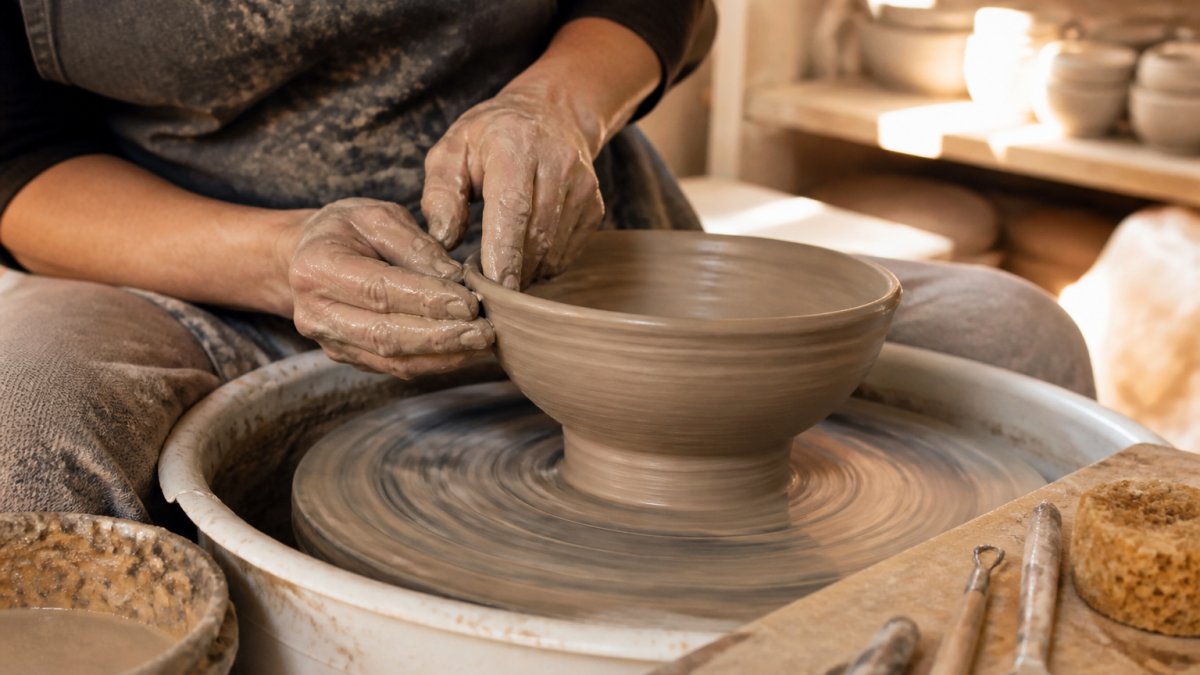
Wheel Throwing, Hand-Building, and Trimming
Wheel throwing centers the clay on a spinning wheel and pulls it up into a wall of even thickness. Hand-building builds forms from slabs, coils, or pinched clay. Both demand control that takes years to develop.
Trimming comes after a partial dry, when the clay is leather-hard. That is when the foot ring gets cut and the walls get refined. Trim too early and the piece collapses. Trim too late and it crumbles.
Glazing, Decoration, and the Final Firing
Glazing is where a piece becomes itself. Dipping, pouring, brushing, carving through slip, layering glazes that interact in the kiln: every choice changes the outcome.
Then comes the bisque firing, the glaze firing, and the slow cool-down. We fire to cone 6, which takes a full day of careful ramping and an equally long cooling period. Open the kiln too soon and the glaze can craze or the ware can crack.
How Long Does It Take to Make Pottery? The Real Hours Behind One Piece
A simple mug takes roughly two to four hours of active work spread across two to three weeks of drying and firing. The calendar time matters as much as the hands-on time, because the studio is committed to that piece the entire stretch and the kiln cannot be rushed without cracking the ware.
Here is where the hours land for a straightforward wheel-thrown mug:
- Wedging and weighing: 10-20 minutes
- Throwing on the wheel: 15-40 minutes
- Drying to leather-hard: 1-3 days
- Trimming and refining: 15-30 minutes
- Drying to bone-dry: 3-7 days
- Bisque firing and cooling: about 24 hours
- Glazing and decoration: 20-45 minutes
- Glaze firing and cooling: another 24 hours
That adds up to hours of skilled labor wrapped around days of waiting. But the mug is the easy case. The hours scale sharply with the form and the method, and that is where the price differences between pieces come from.
By form. A simple mug is the low end. A decorated vessel with carved texture or layered glaze adds decoration time and a higher failure rate, because every carved line is a chance to cut too deep and every extra glaze layer is a chance for a run. A complex teapot is the high end: body, lid, spout, and handle are often thrown or built separately, then joined at the leather-hard stage, and a spout that does not pour cleanly means the whole piece is reworked or scrapped.

By production method. Wheel throwing is fast per piece once the maker is skilled, but every piece is individual and none can be perfectly duplicated. Hand-building from slabs or coils is slower per piece and rewards patience over speed. The method a maker chooses is a trade-off between speed, consistency, and the individuality that buyers of handmade work are paying for.
By firing schedule. Because the kiln runs as a batch, the maker's real constraint is how many pieces fit in a load and how long the load occupies the kiln.
Handmade Pottery Pricing: Where the Money Actually Goes
Handmade pottery pricing comes down to four buckets: materials, firing, time, and studio overhead. None of them are optional, and all of them are paid before a piece ever sells.
Materials. Glaze materials, stains, and oxides add up, especially on layered or carved surfaces where color pools and breaks.
Firing. Every piece is fired twice, bisque and glaze, and a kiln load costs roughly the same to run whether it is full or half empty.
Time. The active hours from the process section above are the largest line item, and they are paid at a rate that keeps a small studio running.
Studio overhead. Rent, wheels, shelving, insurance, the kiln itself, and the test tiles and failed experiments that never reach a listing.
Breakage and failed firings. This is the quiet line item. A glaze that runs onto the shelf, a crack at the rim, a warp in the base: those pieces are paid for by the ones that survive.
Selling costs. If a piece sells through a marketplace or gallery, commissions and payment processing fees come out of the retail price before the maker sees anything.
A handmade price is not a markup on clay. It is labor plus materials plus a share of firing and overhead plus a reserve for failures and selling costs. When you see a price, you are seeing all of those buckets at once.
The most common mistake buyers make is comparing a handmade mug to a mass-produced one on price alone. Those are different products made by different processes.
The Skill and Years of Practice Behind Every Piece
Skill is the largest invisible cost. Centering clay consistently, pulling an even wall, and judging when a piece is dry enough to trim are all skills built over years of practice, not weeks.
A potter learns by ruining pots. Collapsed walls, cracked handles, glazes that looked wrong after firing: every one of those teaches something a tutorial cannot. That accumulated judgment is what lets a maker look at a freshly thrown bowl and know it will survive the kiln.
It also shapes design decisions. At brilliantbluejay pottery, texture and the sensory experience of a piece matter as much as the glaze, so forms get carved and altered to feel good in the hand. That kind of decision-making is not something a production line does.
Why Every Piece Is One-of-a-Kind (And Why That Matters)
No two handmade pieces are identical, because clay, glaze thickness, kiln position, and the maker's hand all vary slightly. Those variations are the signature of studio pottery, not a defect.
A glaze that pools lighter on high spots and darker in the grooves, a rim that leans a few degrees, a caramel tone that reads warmer in daylight than in a photo: these are the marks of a piece made by a person. Mass-produced ceramics are engineered to look the same, which is a different goal entirely.
That uniqueness is also why a photo never quite matches the piece that arrives. It is the same reason we photograph work in natural light and describe color shifts honestly.
When a listing says a color reads warmer or darker in person than in photos, believe it. Handmade glazes shift with the light, and a maker who tells you so is giving you accurate expectations, not a disclaimer.
How to Identify Handmade Pottery and Judge Its Quality
You can identify handmade pottery by looking for slight asymmetry, visible throwing rings, a trimmed foot ring, and glaze variation that follows the form. None of those are flaws.
Run through this checklist before you buy:
- Foot ring: a clean, trimmed ring on the base signals wheel work and hand finishing.
- Wall consistency: even thickness with a slightly thicker base for durability.
- Glaze behavior: pooling in recesses and breaking lighter on ridges, not a flat uniform coat.
- Weight and balance: a well-made mug feels settled in the hand, not top-heavy.
- Maker transparency: clay body, firing temperature, and care instructions stated plainly.
- Function tested: a teapot pours without dripping, a cup rim feels comfortable to drink from.
Durability comes down to firing temperature and glaze fit. Stoneware and porcelain fired to cone 6 produce a dense, vitrified body that handles daily use well when the glaze is properly fitted to the clay.
Caring for Handmade Stoneware So It Lasts for Years
Handmade stoneware lasts for years with modest care: wash it by hand or on a gentle dishwasher cycle, avoid sudden temperature shocks, and skip the microwave on any piece with metallic or heavily textured glaze surfaces.
The practical habits that matter most:
- Let a hot piece cool before rinsing it in cold water.
- Do not move a piece straight from freezer to oven.
- Stack with a cloth between pieces to protect rims and carved surfaces.
- Treat carved and textured surfaces gently; a soft brush beats a scouring pad.
A yunomi-style cup, for example, is designed to be cradled in both hands so you can feel the temperature of the tea. That sensory relationship is the whole point, and gentle care keeps it intact.

Frequently Asked Questions
Why is handmade pottery so expensive?
Handmade pottery pricing reflects hours of work that mass production eliminates. A single mug can take two to three hours of active labor across throwing, trimming, glazing, and kiln loading, plus days of drying and firing time. Add clay and glaze materials, kiln electricity, studio rent, and the potter's years of practice, and a $30 mug starts to look reasonable. Mass-produced ceramics spread those costs across thousands of identical units made by machine and low-wage labor; a studio potter spreads them across one piece at a time.
How can I tell if pottery is handmade?
Look for small irregularities: slight variations in wall thickness, a foot ring with subtle tool marks, glaze pooling unevenly in carved grooves, and a signature or stamp on the bottom. Handmade pottery often shows faint throwing rings on the interior. Mass-produced ceramics tend to be perfectly uniform, with seams from molds and identical glaze patterns on every unit. If you see dozens of pieces that look exactly alike, you are likely looking at cast production. When in doubt, ask the maker about their process.
How long does it take to make a piece of handmade pottery?
Active labor for a simple mug runs about 30 to 60 minutes across throwing, trimming, and glazing, but the full timeline is longer. Pieces need one to three days of drying before trimming, then another few days to a week of drying before the first firing. Bisque firing takes a day, glazing another session, and the glaze firing another day plus cool-down. From wet clay to finished piece, expect one to three weeks per batch, with the potter's hands on it repeatedly throughout.
Is handmade pottery worth the price compared to cheaper alternatives?
It depends on what you want from the piece. Handmade stoneware fired to cone 6 is dense, durable, and made to be used daily; a well-made mug can last decades with basic care. You are also buying a specific form, glaze, and texture that no factory is reproducing, plus the story of the person who made it. If you want a uniform set of twelve identical plates, mass production wins on price. If you want a piece that feels like yours, handmade pottery delivers value a factory cannot.
Buying handmade means choosing a piece that carries a maker's decisions, hours, and judgment in it. If you want stoneware and porcelain that bring color and texture into daily use, brilliantbluejay pottery throws each piece in small batches, finishes it in glazes that echo abstract landscapes, and fires it to cone 6 for everyday durability. Browse the carved yunomi cups, the seashell ruffled bowl, or the carved teapot in frosty blue, and shop the latest to find the one that feels like yours.