

A Guide to One of a Kind Handmade Pottery
Last Updated: October 30, 2026
Quick Summary
One of a kind handmade pottery is a single wheel-thrown piece shaped, carved, glazed, and fired by an artist, with no mold and no duplicate run behind it. Every piece of handmade pottery from brilliantbluejay is thrown by hand in their Royal Oak, Michigan studio, so the weight, rim, and glaze break exist exactly once.
- Handmade stoneware is made by wedging, throwing, trimming, carving, drying, bisque firing, glazing, and firing again.
- Check the rim, foot ring, glaze pooling, carving depth, and weight to tell handmade pottery from molded work.
- Let a cold mug reach room temperature before pouring boiling water in to avoid thermal shock.
- Ask what clay body a piece uses and whether its interior glaze is formulated for food contact.
- Brilliantbluejay fires only to cone 6 and works primarily in a stoneware and porcelain mix.
Table of Contents
- Why One of a Kind Handmade Pottery Feels Different in Your Hands
- How Handmade Stoneware Pottery Is Made, Start to Finish
- How to Tell If Pottery Is Handmade
- Choosing Handmade Pottery Mugs and Vessels by Use and Form
- How to Care for Handmade Pottery Beyond Appliance Safety
- Materials, Glazes, and Food Safety Questions to Ask
- What Sets Brilliantbluejay Pottery Apart
- Shop the Latest One of a Kind Pieces
- Frequently Asked Questions
Why One of a Kind Handmade Pottery Feels Different in Your Hands
One of a kind handmade pottery is a single wheel-thrown piece shaped, carved, glazed, and fired by an artist, with no mold and no duplicate run behind it.
That difference shows up the moment you pick a piece up. A handmade stoneware pottery mug sits a little heavier in the palm.
Mass-produced dinnerware is built to be identical. Handmade work is built to be itself.
Below, we walk through how these pieces are made, how to spot genuine handmade work, how to choose and care for it, and what to ask about materials and glazes before you buy. If you have ever wondered why handmade pottery costs more than a shelf full of lookalikes, the answer lives in every step of that process.
How Handmade Stoneware Pottery Is Made, Start to Finish
Handmade stoneware pottery is made by wedging clay, throwing the form on a wheel, trimming and carving it at the leather-hard stage, drying it slowly, bisque firing it, glazing it, and firing it again to maturity.
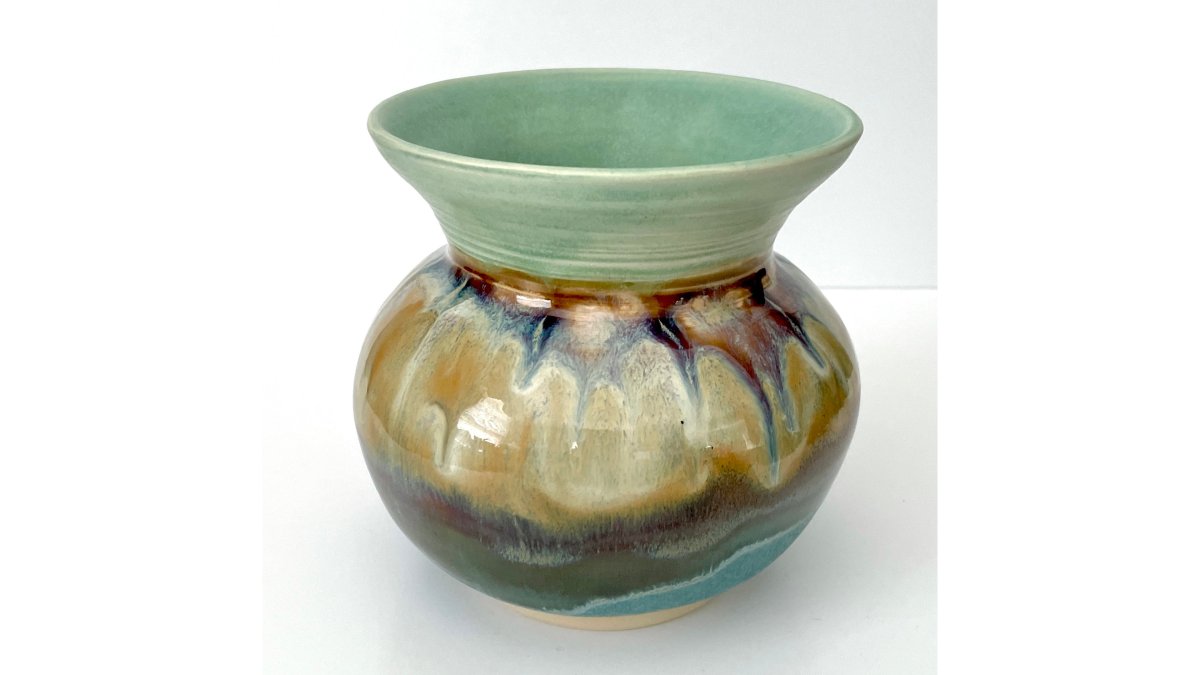
Our clay body is a stoneware and porcelain mix, usually a very low grog, fine blend. Occasionally we throw a low grog stoneware instead, and that gets noted on the piece.

Wheel Throwing and Hand Carving
Throwing sets the bones of a piece: the height, the belly, the neck, the foot. Trimming tidies the base. Then comes the part we care about most, the carving.
Texture is not decoration layered on at the end. It is the piece. A carved surface changes how a vase feels when you lift it, how light moves across it, how glaze pools in the low points and thins over the ridges.
Glaze Reactions and Cone 6 Firing
We fire only to cone 6.
A single glaze can read as peachy pink and cream where it settles into grooves, then deepen to warm brown where it breaks over a ridge. How to choose pottery glaze colors walks through picking colors for your own pieces.
How to Tell If Pottery Is Handmade
Handmade pottery shows small irregularities in form, wall thickness, glaze pooling, and the foot ring. Those tiny asymmetries are the most reliable evidence you are holding something an artist shaped rather than a mold released.
Here is what we would check on any piece:
- The rim. Run a fingertip around it. A thrown rim has subtle variation in thickness; a molded rim is identical all the way around.
- The foot ring. Flip the piece over. Trimming marks, a slightly uneven ring, or a signature tells you a person finished the base.
- Glaze pooling. On handmade work, glaze gathers in low spots and thins on high ones. Mass-produced coverage tends to be flat and even.
Ask the maker directly how the piece was formed.
Choosing Handmade Pottery Mugs and Vessels by Use and Form
Choose handmade pottery by matching form to daily use: a handleless yunomi for tea, a handled mug for coffee, a wide-shouldered vase for a mantel, a squat carved vase for a shelf.
For coffee, the grip matters more than the ounce count. For a deeper look, see our guide to the best ceramic mugs for coffee. Our Carved Yunomi Cups take the opposite approach: a traditional handleless Japanese teacup, taller than it is wide.
For vases, think about where the piece will sit before you fall for a photo. Our Carved Vase in Chocolate Stoneware measures 7 x 7 inches and weighs 3.75 lbs. The Serendipity Vase is 5.75" wide x 5.5" tall.
| Piece | Best For | Why It Works |
|---|---|---|
| Carved Yunomi Cups | Daily tea, slow mornings | Handleless form warms both hands |
| Serendipity Vase | Small shelves, bedside tables | Compact bulbous form, satiny glaze |
| Carved Bottle Vase | Entryway or dining table | Tall neck, dramatic single-glaze break |
| Carved Vase in Chocolate Stoneware | Mantels, large surfaces | Wide shoulders, deep carved texture |
| Sgraffito Vase - Daisies | Gifts, cheerful accents | Carved daisy pattern under clear glaze |
How to Care for Handmade Pottery Beyond Appliance Safety
Caring for handmade pottery goes past the microwave and dishwasher question. Treat a handmade piece with care: use it often, clean it gently, and avoid sudden temperature changes.
Thermal Shock, Explained
Thermal shock happens when one part of a piece heats or cools much faster than another, and a sudden temperature swing can stress a piece.
The risk is highest with thick-walled pieces and with any piece that has just come out of a hot oven or a boiling pot. The practical rules:
- Let a cold mug come to room temperature before pouring boiling water into it. A pre-warm with tap water is enough.
- Never set a hot piece on a cold stone counter or run it under cold water straight from the oven.
- Do not pour cold liquid into a hot vessel, and do not move a piece from freezer to oven.
Glaze Care: Crazing, Staining, and Abrasion
Glaze is glass. It can craze (develop a fine web of surface cracks), stain (absorb color into those cracks or into an unglazed foot), and abrade (lose its shine where a scrubber or a stack of plates has rubbed it).
- Crazing. A faint crackle pattern is often a normal surface feature, not structural damage. If you can feel a crack with a fingernail, or if the piece is used for food and the crazing is on the interior, retire it from food use. Crazed interiors can harbor residue.
- Staining. Tea, coffee, tomato, and turmeric are the usual culprits. A paste of baking soda and water, left on for a few minutes and rinsed, lifts most surface staining without dulling the glaze. Avoid chlorine bleach on carved or matte surfaces.
- Abrasion. Steel wool, gritty cleansers, and scouring pads scratch glazed surfaces. A nylon brush or a soft sponge handles most residue. Give carved pieces breathing room.
Washing and Storing by Piece Type
| Piece | Wash | Store | Watch For |
|---|---|---|---|
| Handled mug | Hand wash preferred; top rack if dishwasher-safe | Upright, not stacked rim-to-rim | Chips at the rim and handle joint |
| Handleless yunomi | Hand wash | Upright, with a little space | Cracks from sudden heat |
| Carved vase | Hand wash; rinse promptly after use | On a shelf, not against a wall | Residue caught in deep grooves |
| Sgraffito piece | Hand wash; soft sponge only | Upright, away from direct sun | Fading or dulling of the clear glaze |
A few habits that make a real difference:
- Rinse promptly. Letting food or drink sit in a carved piece gives residue time to work into the texture.
- Dry fully before storing. Let pieces air dry completely, upside down on a towel.
- Skip the thermal swing. Do not pour boiling liquid into a cold mug or run a hot piece under cold water. Let it come to room temperature first.
If a piece develops a faint crackle in the glaze, that is often a normal surface pattern rather than structural damage. If you can feel a crack with a fingernail, retire the piece from food use.
The short version: avoid sudden temperature changes, wash by hand when you can, skip abrasives, and dry before storing. Those four habits cover most of what shortens a handmade piece's life.
Materials, Glazes, and Food Safety Questions to Ask
Ask any potter what clay body a piece is made from and what glaze is on it. The answers tell you more about a piece than any product photo, and a maker who answers clearly is telling you something about how they work.
What Food-Safe Actually Means
Food safety means the glaze on a food-contact surface is formulated and fired to be stable, so it does not leach unwanted material into what you eat or drink. Two things have to line up: the glaze recipe has to be balanced for the firing range, and the kiln has to reach the maturity point the glaze was designed for.
A glossy surface is not proof of food safety, and a matte surface is not proof of the opposite. The glaze formulation and the firing are what matter.
Reading a Piece Before You Buy
You can learn a lot from a piece in person or from clear photos:
- The interior. A food-contact interior should be fully glazed, with no dry patches, pinholes, or rough spots. Run a fingertip across it.
- The rim. A glazed rim is easier to keep clean than a bare one. A bare rim is not automatically unsafe, but it is more porous and stains more readily.
- The foot. An unglazed foot ring is normal and helps a piece sit flat. It is not a food-contact surface, so keep it dry and wipe it clean.
Questions to Ask, and What the Answers Mean
Here is what we would ask, in plain language, and how to read the reply:
- What clay body is this piece made from, and is it stoneware, porcelain, or a mix? A stoneware and porcelain mix is common for functional work; the answer tells you how the piece will behave with heat and daily use.
- Is the interior glaze formulated for food contact? A clear yes, with a note about which glaze, is a good sign. A vague answer is a reason to ask again.
- Is any part of the piece decorative only, such as an unglazed foot or an exterior texture? Knowing which surfaces are food-contact and which are not helps you use the piece correctly.
Decorative Versus Functional
Some pieces are made to be looked at, not eaten from. A sculptural vase, a piece with a decorative interior glaze, or a vessel with an unglazed interior is not a failure of food safety; it is a different use. The key is to know which you have. If a piece is decorative only, keep it out of the kitchen rotation and enjoy it for what it is.
Food safety comes down to two things: a glaze formulated for food contact, and a firing that reached the temperature the glaze was designed for. Ask about both, and buy from makers who answer clearly.
What Sets Brilliantbluejay Pottery Apart
Brilliantbluejay pottery offers wheel-thrown stoneware and porcelain pieces, handcrafted by artist Jamie Thomson in a Royal Oak, Michigan studio and finished in small batches. We fire to cone 6, work primarily in a stoneware and porcelain mix, and let natural variation show.
What that means for you: no two pieces match. Our Carved Bottle Vase in Chocolate Clay shows a single glaze reacting to the chocolate clay and the carving, landing in tones of dark brown, creamy white, and hints of orange and blue. Our Sgraffito Vase - Daisies is carved in chocolate clay under a clear glaze, cheerful and completely singular.


Each piece is finished in small batches with unique glazes, so no two pieces are identical. If you want something that feels special rather than like the same bowl everyone else owns, that is the trade: you get a piece with its own character, and you accept that the next one will be different.
Shop the Latest One of a Kind Pieces
New work lands in small batches, and the best pieces tend to move quickly. Browse the vases and decor collection to shop one of a kind pieces.
Frequently Asked Questions
What makes handmade pottery one of a kind?
Every piece passes through a human hand at every stage, so no two come out identical. The clay body, the thickness of the wall, the depth of a carving line, and the way glaze pools in a groove all shift slightly from one piece to the next. Glaze reactions in the kiln are especially unpredictable: the same recipe over the same clay can break brown in one spot and cream in another. That is why a wheel-thrown vase or carved yunomi cup is genuinely singular rather than a copy of a design.
How can you tell if pottery is handmade?
Look for small irregularities that machines do not produce: slight variations in wall thickness, a foot ring with tool marks, glaze that pools unevenly in carved lines, and a base that is not perfectly flat. Hand-carved decoration usually shows changes in groove depth. Ask the maker how the piece was formed and fired. Ask the maker about the clay body, the firing cone, and the glaze used on that piece.
Is handmade pottery safe for everyday use?
Functional pottery is made to be used, but safety depends on the clay, the glaze, and how the piece was fired. Ask whether the glazes are food safe and lead-free, and whether the piece is intended for food contact or only for decoration. Confirm the glaze and intended use with the maker before buying if you plan to serve food in a piece.
How do you care for handmade pottery?
Hand washing is the gentlest option and keeps glazes looking their best over time. Avoid sudden temperature changes, such as moving a cold piece straight into a hot oven or pouring boiling water into a chilled mug, because thermal shock can crack clay. Skip abrasive scouring pads on glazed surfaces. Check with the maker about microwave and dishwasher suitability for each specific piece before relying on either.
What is the difference between stoneware and porcelain?
Stoneware is fired from a clay body that is durable, slightly heavier in the hand, and often warmer in tone. Porcelain is finer, denser, and can be thrown thinner, which gives it a lighter feel and a brighter surface. Many potters blend the two to get the strength of stoneware with the refinement of porcelain.
How do you choose a handmade pottery mug or bowl?
Start with how you will use it. A morning coffee mug should feel balanced when full and fit your hand comfortably; a yunomi-style cup is designed to be cradled in both hands. Check the capacity and the height against what you already reach for. For bowls, consider whether you want a wide rim for serving or a deeper shape for cereal and soup. If you are gifting, ask the maker about the piece's story, since that narrative is often part of what makes it special.
Choosing handmade pottery asks you to slow down and pick with your hands, not just your eyes, and to trust a maker whose work you can follow over time. At brilliantbluejay pottery, every piece is thrown, carved, and glazed by hand in small batches, with natural glaze reactions and texture you can feel every time you use it. Get started with brilliantbluejay pottery and bring a piece into your home that no one else owns.
